Road Access to Remote Nevada State Parks: Gravel, Grades and Notices
A remote Nevada state park can look close on a map and still involve a road that is a poor match for your vehicle. The safest plan starts before departure: check official access notices, understand the route description, and decide whether your car, trailer or RV is suited to the approach.
Why road access deserves its own planning
A campground reservation or a park visit plan does not tell you everything about the road leading there. Access can be a separate question: what the road is like, whether it is open, whether recent conditions have changed, and whether your vehicle can reasonably handle the route. Treat these as different checks rather than assuming that a destination listing answers them all.
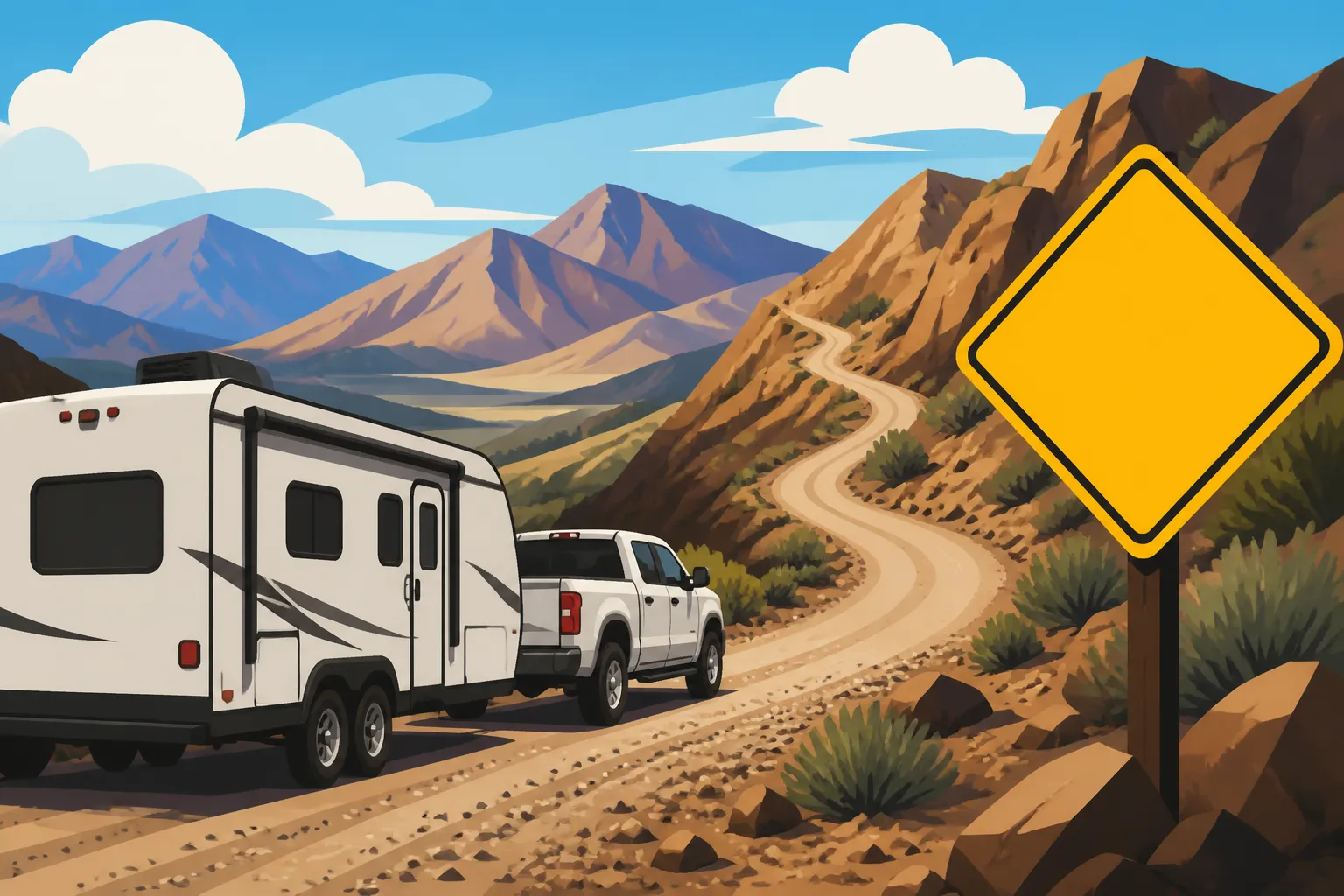
This is especially important when the drive includes an unpaved road, a steep or uneven section, or a route with few convenient places to turn around. The word “remote” does not tell you what a particular road is like, and a general description is not a guarantee about current conditions. A route that is comfortable for one vehicle or driver may not suit another.
The aim is not to avoid every rough road. It is to make a clear decision before you are committed to a route. That means checking the latest official information, considering the whole vehicle combination rather than just the tow vehicle, and having an alternate plan if the road or your comfort level does not match expectations.
It also helps to separate access planning from campsite planning. A site may be suitable for your tent or RV once you arrive, while the access road presents a separate challenge. For help comparing a rig with a site, see Matching Your Tent, Trailer or Rig to a Nevada Park Campsite. If you are traveling by RV, Will Your RV Fit? Length Limits at Nevada State Park Campsites can help you think through campsite fit, but road suitability still needs its own check.
A useful plan answers practical questions before you leave:
- What does the park say about the access road?
- Is there a current closure, construction notice or access update?
- Is the guidance specific to your vehicle type?
- Would you be comfortable turning around if the road feels unsuitable?
- What is your backup destination if you decide not to continue?
If any important detail remains unclear, do not fill the gap with an assumption. Look for current information from the Nevada Division of State Parks, and decide whether to ask the park through its official contact information. The purpose of checking is not to prove that a drive will be easy; it is to know enough to make a sensible go-or-no-go decision.
Read road descriptions as practical guidance, not a guarantee
A road description is most useful when you translate it into questions about your own trip. Words such as unpaved, gravel, steep, narrow or rough describe different potential challenges, but they do not provide a complete picture of the route. The same word can also mean different things to drivers with different vehicles, experience and tolerance for a slow or bumpy drive.
An unpaved road may call for a different pace and more attention than a paved road, but the label alone does not tell you its present condition. Rain, maintenance, traffic and other changes can affect what a road is like when you arrive. If the park provides a general route description, use it to prepare, then check for current notices that could change access.
The Nevada Division of State Parks describes Cave Lake’s access this way: Access roads to campsites are unpaved. That is a useful planning detail, but it does not answer every question about a particular vehicle, the current road surface or the conditions on your travel day. If you are considering Cave Lake, factor the unpaved access into your choice of vehicle and your expectations for the drive, then review the current notices before setting out.
For Kane Springs Road, the Nevada Division of State Parks says: Not suitable for those towing trailers or for motor homes. That is a direct vehicle-fit warning, not merely a note that the road might be bumpy. Anyone towing a trailer or driving a motor home should take that restriction seriously and should not plan to use that road with those vehicles. If your travel party includes a separate car, confirm the route and access details for that vehicle too rather than assuming that one vehicle’s suitability applies to the whole group.
| Road information | What it can help you decide | What it does not establish by itself |
|---|---|---|
| Unpaved access | Whether you are comfortable driving on a surface that is not paved | The current condition or suitability for every vehicle |
| A warning for a vehicle type | Whether your vehicle combination is a poor match for the named road | Whether an alternative route is available |
| A closure or construction notice | Whether the planned approach may be affected | Whether the notice has changed since you checked |
| A general route description | What questions to ask before departure | A guarantee that the road will feel manageable |
When reading a road description, look for details that affect your particular setup. A car pulling a trailer is not the same as a car traveling without one. An RV and its driver may have different needs from a small passenger vehicle. A narrow route may matter more when turning around is difficult. If an official description rules out a vehicle type, do not treat your own confidence or past experience as a substitute for that information.
Some road questions cannot be answered from a campground listing or a map alone. If an official page does not say whether a route is suitable for your setup, seek current clarification before departure. Explain the vehicle type and whether you are towing; a broad question such as “Is the road okay?” may not give the park enough context to provide useful guidance.
When the available information leaves you uncertain, uncertainty is itself useful for planning. You can choose a different park, travel in a vehicle better suited to the approach, or postpone the trip until you can confirm the route. Those choices are less costly than continuing down a road after realizing that you are uncomfortable or that the vehicle is a poor fit.
For route-specific preparation beyond park access, Driving to a Remote Nevada State Park: Fuel, Water and Signal covers the practical supplies and communication questions that can matter when traveling to a remote destination. Road condition and vehicle suitability remain separate checks, but they fit into the same broader plan.
Match the road to the whole vehicle combination
A vehicle decision should account for everything traveling together, not just the engine or the driver’s confidence. A tow vehicle pulling a trailer has different length, handling and turning considerations from the same vehicle traveling alone. A motor home is also a distinct setup. If the park or official road information names a vehicle type that is unsuitable, use that information to rule out the route for that setup.
Before departure, write down or otherwise confirm the details that matter to the access decision:
- Whether you are driving a car, truck, motor home or another vehicle.
- Whether a trailer is attached.
- Whether the vehicle combination can turn around where needed.
- Whether everyone traveling understands the route’s limitations.
- Whether the driver is comfortable proceeding at a cautious pace on the described surface.
This is not a technical inspection checklist. It is a way to avoid overlooking the basic mismatch between a road and the vehicle using it. If you are unsure whether a warning applies to your exact setup, do not assume that a different name for your vehicle makes the warning irrelevant. Confirm the intended meaning with the official park contact.
A vehicle that can physically move along a road may still be a poor choice for it. Practical suitability also includes how manageable the drive feels, whether you can respond to a change in conditions, and whether you have room to stop or turn around if needed. Keep your decision conservative when the route description and your own comfort do not line up.
If you are traveling with more than one vehicle, plan for the least-suited vehicle, not just the one that handles the road most comfortably. A group can become separated if one vehicle decides to turn back, and that can complicate arrival, supplies and campsite plans. Discuss the route and the fallback plan before anyone sets out, so a driver does not feel pressured to continue simply because others are already committed.
For an RV or trailer trip, campsite dimensions and access are separate parts of the decision. A site that fits your rig does not necessarily mean the road to the campground is appropriate for it. Likewise, an access road that is manageable for your vehicle does not guarantee that a specific site fits. Consider both questions independently and use An RV Site Checklist for Reserve Nevada: Length, Hookups, Pad Type as a companion when you are checking site details.
If the route is not a fit, changing the plan is a sound outcome. You might leave the trailer elsewhere only if you can do so safely and legally, choose another destination, or travel in a different vehicle. Do not improvise a place to leave equipment or assume that a nearby pull-off is suitable for parking. Confirm any alternative arrangement before relying on it.
Vehicle choice can also affect how much flexibility you have once underway. A smaller vehicle may be easier to turn around in some circumstances, but that does not make every road suitable for it. A high-clearance vehicle may help on some surfaces, but it does not override an official restriction or a closure. Do not convert a general vehicle characteristic into a guarantee about a specific route.
If you are planning a multistop trip, assess access separately for each park. Do not assume that because one unpaved approach was manageable, every unpaved road on the route will feel the same. The access description and notice for each destination should inform that leg of the trip. The article Road Trip Across Nevada State Parks: Permit, Bookings and Stay Caps can help with other pieces of a multi-park plan, while each road still deserves its own current check.
Check official notices close to departure
Road conditions and access information can change after you start planning. A page you reviewed while choosing a destination may not reflect a later construction update, closure or other notice. For that reason, check the park’s current official information again close to departure, not only when you first make plans.
The Nevada Division of State Parks’ official News and Public Notices page lists park-specific closure and access updates. One example notice is Road Construction near the entrance of Old Las Vegas. A notice may be limited to one location or one part of access, so read the full item and identify what it says about your intended route rather than relying on its heading alone.
A practical notice check looks like this:
- Start with the official News and Public Notices page.
- Look for notices related to the park and the route you intend to use.
- Read the full notice, including the location and any stated timing or access details.
- Check whether it describes a full closure, a change to access or construction near the route.
- Recheck close to departure and again when you arrive if the trip is underway.
The last check matters because plans made in advance can meet conditions that have since changed. If you are already traveling, pause somewhere safe to review official information rather than trying to read while driving. If a notice is unclear, use the official website to find current contact details and ask for clarification before continuing toward the affected road.
A public notice is not a substitute for every kind of road-condition check. It may explain a closure or project without describing the surface in detail. A route description may explain that access is unpaved without telling you about a recent issue. Use each kind of information for what it actually says, and avoid treating the absence of a notice as proof that a road will be easy or unchanged.
Make sure you are checking the right destination. Similar place names or a general search result can lead to information that is not about the park or access road you plan to use. Confirm that the notice names the intended park or road, then match it to your route. If the notice refers to an entrance or a section of road, work out whether that is the same entrance you expect to take.
It can help to keep a short note of what you checked and when, especially if your route has several legs. This is a planning aid, not proof that conditions will remain the same. If you are traveling over a longer period, repeat the check before each remote approach instead of relying on a single review at the start of the trip.
For broader closure planning, see Checking Nevada State Park Campground Closures and Public Notices. For wet-weather considerations, Checking Wet-Weather Road Conditions Before a Nevada State Park Trip is a useful companion. Neither replaces reading the specific park notice that applies to your planned access.
Build a flexible plan before you leave
Good access planning is more than looking up a road and deciding to go. It is also deciding what you will do if the route is closed, unsuitable for your vehicle, or more difficult than you are comfortable handling. A fallback plan keeps a road decision from becoming a stressful argument at the point where turning around may be awkward.
Choose a backup destination or a different activity before departure. The alternative should work for the people and vehicles in your group, not just appear nearby on a map. Do not rely on a spur road, informal parking area or unverified route as an escape option. Confirm the alternative through official information and make sure you can reach it with the vehicle you are using.
Share the plan with everyone traveling. Explain the road description, any vehicle warning and the point at which the group will stop or turn back. Agree that a driver can choose not to continue if the road feels unsafe or the official information does not support proceeding. That agreement helps keep a cautious decision from being treated as a last-minute inconvenience.
Think through what you need if the trip takes longer than expected. Pack the supplies appropriate to your itinerary, and do not assume that every remote destination has the services you are used to. Packing Water for a Desert State Park Day in Nevada can help with water planning, while Driving to a Remote Nevada State Park: Fuel, Water and Signal covers a wider set of remote-drive preparations. Check park-specific information for any services you intend to rely on.
A paper or offline copy of essential route information can be a useful backup if you cannot conveniently access a page while traveling. Save the park notice and directions before setting out, but remember that saved information can become outdated. Use it for reference and check the official source again when possible. Do not treat an old screenshot as proof that a route is still open.
Plan when you will make the final access decision. For example, you may decide to review notices before leaving your last convenient stop, then pause safely before committing to the final approach if conditions or signs raise a concern. This is not a claim that a particular road has a designated decision point; choose a safe place based on the route and current conditions. Never stop where doing so creates a hazard.
If you are traveling with a group, make sure everyone knows how the vehicles will stay together and what to do if one turns back. Avoid pressuring someone to continue because another driver has already gone ahead. When a route is uncertain, keeping the group’s choices coordinated is more important than preserving the original timetable.
Finally, make room in the itinerary for a change of plan. A remote destination may take longer to reach than expected, and a construction notice or access problem can affect more than the drive itself. A schedule with no flexibility can tempt drivers to press on when they should reassess. If you want broader trip-planning help, Planning a Weekend at a Nevada State Park, From Permit to Campsite covers the other decisions that fit around a park visit.
Make the drive deliberately and reassess when needed
Once you are on the way, stay attentive to the road information you checked and the conditions you actually encounter. Drive at a pace that lets you respond to the surface and visibility. Leave enough room to stop safely, and avoid letting the planned arrival time dictate how fast you travel.
Do not assume that a road will become easier simply because you have already driven part of it. If the surface, route or traffic feels different from what you expected, pause only where it is safe and reconsider. The farther you continue, the more important it may be to know whether there is a safe place to turn around. If you cannot determine that, do not push forward just to preserve the trip.
Watch for official signs and notices on the route. If a posted instruction conflicts with an old note or saved page, follow the current instruction and stop to clarify the situation safely. Do not drive past a closure or attempt to find an unofficial way around it. If the route is blocked or access is unclear, use your backup plan and seek current information through the official website.
A sensible response to an unexpected obstacle is calm and specific:
- Stop in a safe location rather than making decisions while moving.
- Review the latest official notice and the route information you have.
- Consider the vehicle and trailer limitations again.
- Decide whether continuing is appropriate or whether to turn back.
- Tell the rest of your group what the plan is before moving.
If road conditions make you uneasy, that is a reason to reassess, not a challenge to overcome. Continuing because you have already invested time in the trip can make a manageable change of plan more difficult. The goal is to arrive safely, not to prove that every planned route can be completed.
At the destination, follow signs and park directions for access and parking. Do not leave the designated route or drive around a barrier in search of a different approach. If access to the intended campground or site is different from what you expected, verify the situation with the park rather than assuming another road or area is available.
When you return, consider what you learned about the route for future planning, but keep that information in context. Conditions can change, and your experience in one vehicle does not automatically apply to another vehicle, driver or travel day. Share a useful observation without presenting it as a permanent guarantee about the road.
Road decisions are also one part of campground readiness. If your trip includes an overnight stay, separately check the campground’s current availability, site details and any applicable rules. A First Campground Night in Nevada, From Booking to Packing Up can help with the camping side of the plan, but it does not replace the access and notice checks described here.
Frequently Asked Questions
Does an unpaved road mean an RV cannot use it?
Not by itself. An unpaved description tells you the surface is not paved, but it does not establish suitability for every RV or current road conditions. Check the official park information for a vehicle-specific warning and use the latest access notices before deciding.
Can a trailer use Kane Springs Road?
The Nevada Division of State Parks says Kane Springs Road is unsuitable for those towing trailers and for motor homes. Do not plan to take either vehicle type on that road; check official information for any alternative access before traveling.
Where should I check for Nevada state park access updates?
The Nevada Division of State Parks lists park-specific closure and access updates on its official News and Public Notices page. Read the complete notice for your destination and check again close to departure.
What should I do if the road feels worse than expected?
Stop only in a safe place and reassess the route, vehicle and current official information. If you are uncomfortable or cannot confirm that access is appropriate, use your backup plan rather than continuing simply because you have already started the drive.
Sources
- Nevada Division of State Parks — Elgin Schoolhouse State Historic Park | State Parks (checked November 23, 2026)
- Nevada Division of State Parks — Cave Lake State Park | State Parks (checked November 23, 2026)
- Nevada Division of State Parks — News and Public Notices (checked November 23, 2026)
Disclaimer
This article is for general informational purposes only and does not constitute professional advice. Laws, prices and regulations vary by location and change over time. Consult a qualified professional for guidance on your specific situation. Nevada Camping & RV is not a government agency and is not affiliated with any government agency.